
01
The whole subject is one fraction
Load over area. Everything difficult about ground bearing pressure is difficulty in establishing what the load is and what the area is, and there is no third thing.
Ground bearing pressure is the contact pressure one support puts into the ground. That is the entire definition, and the arithmetic is a division.
What makes it a real engineering problem is that both numbers resist being pinned down. The load is not the crane's weight and is not shared evenly. The area is not the mat you can see.
The rest of this article is those two numbers, then what the ground is allowed to take, and then the pad itself, which turns out to have a design of its own.
02
Where the outrigger load comes from
From the manufacturer's chart, if a chart exists. Every other method is a fallback, and should be labelled as one on the calculation.
A mobile crane's outrigger loads are published by the manufacturer for the machine, the configuration and the load case. That chart is the primary source, and if you have it you use it.
Three things about those numbers surprise people:
The distribution is nothing like even. In the worked example below the machine grosses 1000 kN and the worst outrigger carries 350 kN. That is 35 percent on one leg, not 25 percent. The counterweight is behind the slew centre, the boom and load are in front of it, and the resulting couple loads one corner heavily while unloading its diagonal opposite.
The governing case is at a slew angle, not at rest. Rotate the superstructure and the heavy corner moves. The worst reaction over the whole slew range is a different number from the reaction in the elevation on your drawing, and a lift plan that checks one angle has checked one angle.
A leg can come off the ground. At the limit, a support unloads completely and the machine is standing on three. Everything downstream of that point is a different structural problem, and a calculation that quietly redistributes load onto a support carrying nothing is telling you something false with great confidence.
Where no chart is available, the reactions can be estimated from a compression-only support model: the machine's own masses, the boom, the counterweight and the hoisted load, resolved onto four supports that can push but not pull. That is a legitimate method and it is not the same thing as a chart. It should be labelled an estimate everywhere it appears, including in the report you hand over.
03
Pressure under the float, not under the crane
The float is small and the pressure under it is large. On the worked example it is 1.4 megapascals, which is well beyond any soil, and that is the entire reason mats exist.
Take the worst outrigger reaction and divide it by the float area.
In the example that is 350 kN on a 0.5 m square float, so 0.25 square metres, giving 1.40 MPa. Expressed in the units the ground side uses, that is 1400 kPa.
No soil takes that. Firm ground might take 250 kPa; a designed granular platform might take 450 kPa. The float is asking for more than five times the firm ground and more than three times the engineered platform, which is why the float is never the thing standing on the ground.
That fraction is also the sanity check worth doing before anything else on site. If someone tells you the pads are fine, ask what the pressure under the float is. If they answer with the crane's weight divided by four divided by the mat area, three separate errors have already happened.
04
The pad is a structure, not a spacer
A pad only distributes load as far as its own stiffness carries it. Credit for the full plan area is a claim about rigidity, and that claim has to be paid for in thickness.
This is the step that changes answers, and it is the one most often taken for granted.
A mat under a float does not present its plan area to the ground. It spreads the load outwards from the float through its own depth, and how far it spreads depends on how stiff it is relative to the ground beneath it. The conventional model gives a spread angle through the thickness: the loaded square grows by the thickness times the tangent of that angle, on each side, and can never exceed the pad itself.
Credited area under a mat
- is mat thickness
- is the declared spread angle, which is a claim about the mat and defaults to zero
- is the mat's own plan area, which the credited area can never exceed
Run the numbers on a mat that looks generous: a 1.5 m square timber mat, 0.15 m thick, under a 0.5 m square float, so 2.25 square metres of plan area.
That is one fifth of the timber you are looking at.
Crane Ground Bearing Pressure & Outrigger Pad Calculator
Full sizeOpen these inputs
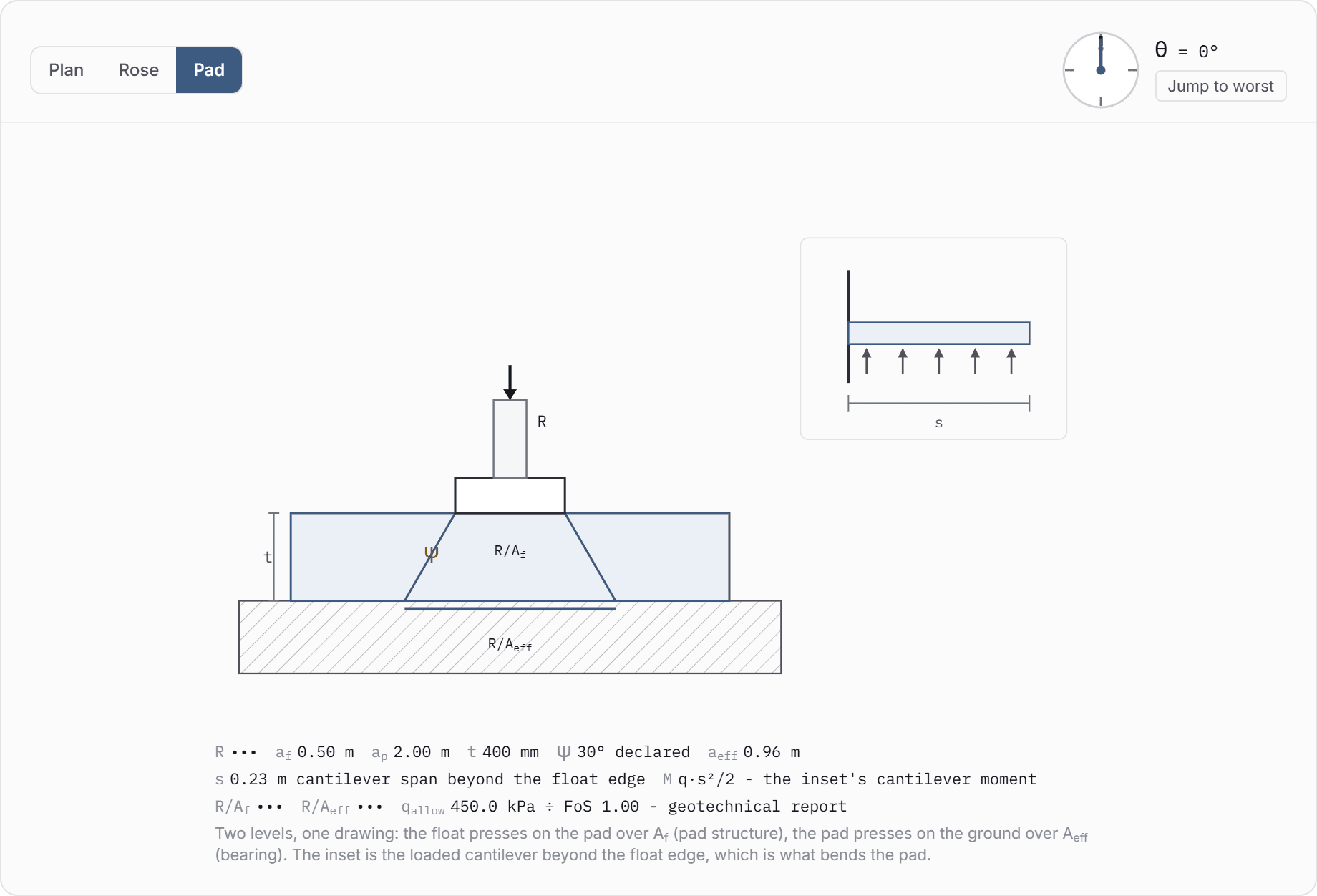
The pressure that reaches the ground is therefore 772 kPa, not the 156 kPa a plan-area calculation would have reported. The plan-area answer is optimistic by a factor of three, in the unconservative direction, on a mat that a site would consider well provided for.
If you want to credit the whole plan area, you are asserting the pad is effectively rigid over that span. That is sometimes true and it is a claim you then have to support, by checking the pad in bending over the full overhang at the pressure you are claiming. What you cannot do is take the area for free and skip the check that would justify it.
The pad also has to survive locally. It carries bending as a cantilever out from the float, one-way shear near the float edge, and punching straight through under it. A large thin mat that punches through under the float has delivered exactly the float's area to the ground, which is where this article started.
05
What the ground is allowed to take
There is no typical allowable bearing pressure you can safely borrow. There are presumed values for preliminary work, and there is a capacity calculated for the ground actually under the outrigger.
Two honest routes exist, and one dishonest one.
A declared allowable. Someone with responsibility states a value for this setup position, and the calculation compares against it. This is the normal case, it is perfectly defensible, and the entire weight of it rests on who declared the number and on what basis.
A calculated capacity. Ground parameters are measured or assumed, an ultimate bearing capacity is computed by one of the classical formulations, and a factor of safety is applied to get a working value. The factor of safety is a declared project decision, not a property of the formula, and the ultimate capacity divided by nothing is not an allowable pressure.
A number from the internet. Presumed bearing values published in tables span roughly an order of magnitude between soft clay and dense gravel, and they carry assumptions about drainage, depth, and the absence of a trench three metres away. A site compound frequently meets none of them. Use a presumed value to size a first guess and then get it confirmed for the position the crane is actually setting up in.
And whatever the value, it applies to the ground as it will be on the day. Rain between the survey and the lift changes it. So does the excavation that appeared last week within the zone of influence spreading down and out from the pad, which is the point at which a lift stops being a lift plan and becomes temporary works with a designer attached.
06
The worked example
One machine, 350 kN on the worst outrigger, worked three times: the mat with no spread credited, the same mat with a declared spread, and the arrangement that actually passes.
Start with the mat as it is usually specified, and with no spread angle declared. With nothing declared, nothing is credited, and the effective area is the float's.
Crane Ground Bearing Pressure & Outrigger Pad Calculator · computed at page render
1.5 m mat, no spread angle declared
The default position: a pad with no declared spread is credited with none, so the ground sees the float's own pressure.
| Worst outrigger reactiondeclared from the chart; 35 percent of a 1000 kN gross | 350kN |
|---|---|
| Float area0.5 m square | 0.25m² |
| Pad plan area1.5 m square timber mat | 2.25m² |
| Effective area creditedno spread angle declared, so no spread credited | 0.25m² |
| Pressure under the float | 1400kPa |
| Pressure reaching the groundagainst a declared allowable of 250 kPa | 1400kPa |
Over the allowable by a factor of more than five. This is not a pessimistic model setting; it is the correct answer to the question actually asked, which was what this pad spreads when nobody has said anything about how stiff it is.
Open this example in the calculatorNow declare a 30 degree spread through the pad's thickness.
Crane Ground Bearing Pressure & Outrigger Pad Calculator · computed at page render
The same mat, with a 30 degree spread declared
Declaring a spread angle is a statement about the pad's stiffness. It is worth doing, and on a thin mat it is worth far less than the plan area suggests.
| Spread gained each sidethickness times | 0.087m |
|---|---|
| Effective area creditedout of 2.25 m² of plan area | 0.45m² |
| Pressure reaching the ground | 772kPa |
| Pad bending stressagainst 16 MPa declared for the timber | 0.77MPa |
| Pad shear stressagainst 1.6 MPa declared | 0.67MPa |
Better by nearly half, and still three times the allowable. The mat is strong enough for the float and nowhere near big enough for the ground, which is the two-level verdict that matters: those are separate questions with separate answers.
Open this example in the calculatorTo pass, the arithmetic says you need about 1.4 square metres of genuine contact on 250 kPa ground. Neither a thicker mat alone nor better ground alone gets there comfortably, so the realistic answer uses both: a 2.0 m mat at 0.4 m thick, standing on a designed granular working platform good for 450 kPa.
Crane Ground Bearing Pressure & Outrigger Pad Calculator · computed at page render
A 2.0 m mat, 0.4 m thick, on a designed working platform
Both levers together. The thicker mat spreads 0.23 m each side instead of 0.09 m, and the platform raises what the ground is allowed to take.
| Effective area creditedout of 4.00 m² of plan area | 0.93m² |
|---|---|
| Pressure reaching the groundagainst 450 kPa for the platform | 378kPa |
| Float bearing on the padagainst 2.5 MPa contact allowable for the timber | 1.40MPa |
| Pad bending stresscantilever out from the float | 0.38MPa |
| Pad shear stressone-way and punching near the float edge | 0.33MPa |
Passing at 84 percent on the ground, with the pad itself barely worked in bending and about a fifth used in shear. Note which pad check is closer to its limit: shear, not bending. On a short stiff overhang that is the normal result and it is the one people forget to look at.
Open this example in the calculator07
Five ways this goes wrong
None of these are arithmetic errors. Each one produces a clean, confident, wrong number, which is why they survive review.
1. Machine weight divided by four. It ignores the couple from boom, load and counterweight, which is the thing that decides which corner is worst. In the example it reports 250 kN where the chart says 350 kN, so every pressure downstream starts out 30 percent light.
2. Plan area credited as contact area. The most expensive error in this subject. On the worked mat the plan area is 2.25 square metres and the spread reaches 0.45, so crediting the plan area overstates the contact by a factor of five, in the unconservative direction, on a mat nobody would have questioned.
3. One slew angle checked. Usually the one in the elevation on the drawing. The governing configuration is found by sweeping the slew, not by picking a picture.
4. The pad checked for bearing only. Bearing on the ground, bearing on the pad, bending, one-way shear and punching are five different checks. The example's final case is comfortable in bending and five times worse in shear, and only one of those two ever gets calculated by hand.
5. Ground conditions taken from the survey and not from the day. Rain, an excavation inside the zone of influence, a buried service, a slope crest nearby: each changes what the ground is allowed to take, and none of them change the number in the calculation unless someone goes back to it.
Common questions
- How do I calculate the ground bearing pressure under a crane outrigger?
- Take the load on the one outrigger that carries most - not the machine weight divided by four - and divide it by the area that is genuinely in contact beneath it. If the float sits on a pad, the contact area is the part of the pad that actually distributes the load, which depends on the pad's own stiffness, not simply its plan area. The governing case is almost never the crane standing still: it is a specific slew angle with the boom over a corner.
- What size crane mat do I need?
- Enough area that the pressure falls below the allowable the ground has been shown to take, and enough thickness and strength that the mat itself survives bending, shear and punching from the float. Those are two different calculations and a mat can pass one and fail the other. A large thin mat that fails in punching under the float delivers no more area than the float did.
- Can I just use the crane manufacturer's outrigger loads?
- Yes, and you should - the manufacturer's chart is the primary source for outrigger reactions, and any estimate is a fallback for when the chart is not available. What the chart does not give you is the pad: it stops at the load coming out of the machine. Sizing the pad, checking the pad, and comparing the pressure to a defensible ground capacity are all still yours.
- What is a typical allowable ground bearing pressure?
- There is no typical value you can safely borrow. Presumed bearing values published for preliminary work span roughly an order of magnitude between soft clay and dense gravel, and they assume conditions - drainage, depth, no adjacent excavation - that a site compound often does not meet. Use a presumed value to size a first guess, then either have the value confirmed for the actual setup position or calculate a capacity from tested ground parameters.
Sources
Every document below is linked at its publisher or regulator. Xarpis reproduces no standard text; where a clause is named, the identifier is given so you can find it in your own copy.
29 CFR 1926.1402Ground conditions (Cranes and Derricks in Construction)
US Occupational Safety and Health Administration · free to read
Requires ground supporting a crane to be firm, drained and graded sufficiently for the manufacturer's specifications, and places the duty to prepare it, and to disclose voids and buried services, on the controlling entity. It states a duty; it prescribes no calculation.
EN EurocodesEurocodes: Building the future
European Commission, Joint Research Centre · free portal
The Commission's own Eurocodes portal: the structure of EN 1990 to EN 1999, the database of Nationally Determined Parameters, and the second-generation timetable. The standards themselves are sold by the national bodies, but the NDP database is free and is what decides which partial factors apply in your country.
LOLER 1998Lifting Operations and Lifting Equipment Regulations
UK Health and Safety Executive · free to read
The UK duty framework for lifting operations: planning by a competent person, supervision, and thorough examination of lifting equipment and accessories. Like OSHA's rules it governs the process, not the arithmetic.
Run the check properly
Reading about a calculation is not the same as being able to hand one over. These tools produce the traceable record.
Something here wrong, or thinner than it should be? Tell us which paragraph and it gets rewritten. Articles carry the date they were last revised for exactly this reason.